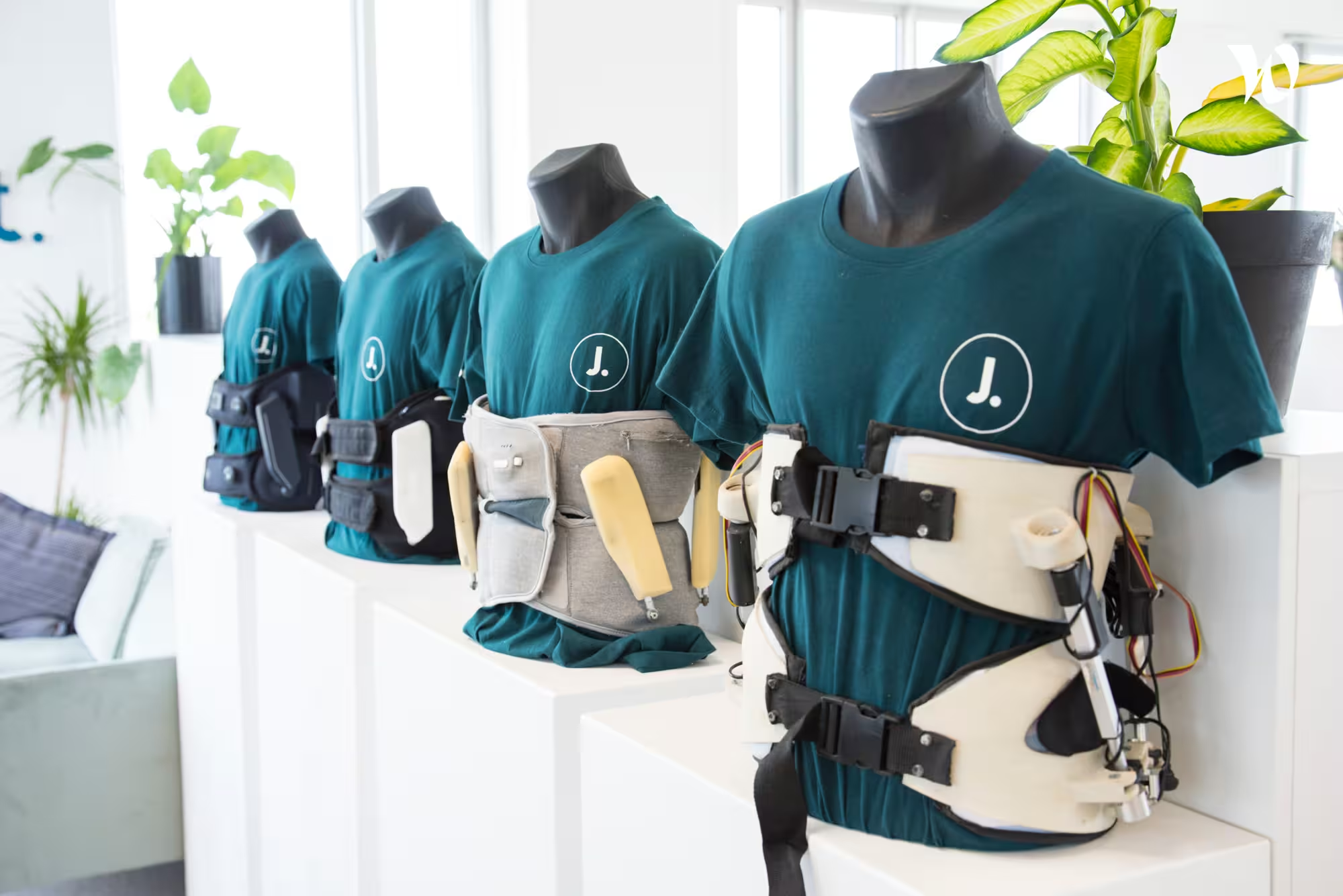
Exoskeletons, also called physical assistance devices (DAPs), have gradually emerged in businesses as a credible response to musculoskeletal disorders (MSDs). Long perceived as experimental or futuristic technologies, they are now concrete tools, integrated into structured approaches to prevent and maintain employment. This evolution is the result of several decades of research, technological iterations and field feedback.
1. The development of a new physical assistance technology
a. From pioneering concepts to technological maturation
The first ideas of mechanical assistance to human movement date back to the end of the 19th century. During the second half of the 20th century, exoskeletons remained mainly confined to research laboratories, with heavy and rigid structures, intended to demonstrate technical feasibility rather than real use. General Electric's Hardiman project, at the end of the 1960s, illustrates this period well: technologically ambitious, but unsuitable for operational deployment.

Starting in the 2000s, the defence sector acted as an accelerator. Major programs, particularly in the United States with DARPA, or in France with projects led by the DGA, CEA or specialized manufacturers, aim to assist soldiers in carrying heavy loads. This work allows significant advances in actuators, sensors, control and energy management. However, the extreme requirements of the military field (robustness, autonomy, compactness) strongly limit large-scale deployments. Above all, these programs served as a technological base.
b. The medical sector as a market catalyst
It was in the medical field that the exoskeleton market was really structured in the early 2010s. Rehabilitation and gait assistance exoskeletons for paraplegic or post-stroke people pave the way for certified, clinically evaluated and marketed products. Pioneering players such as ReWalk, Ekso Bionics or, in France, Wandercraft, are attracting significant investments and showing that an exoskeleton can be used repeatedly, supervised and secured.
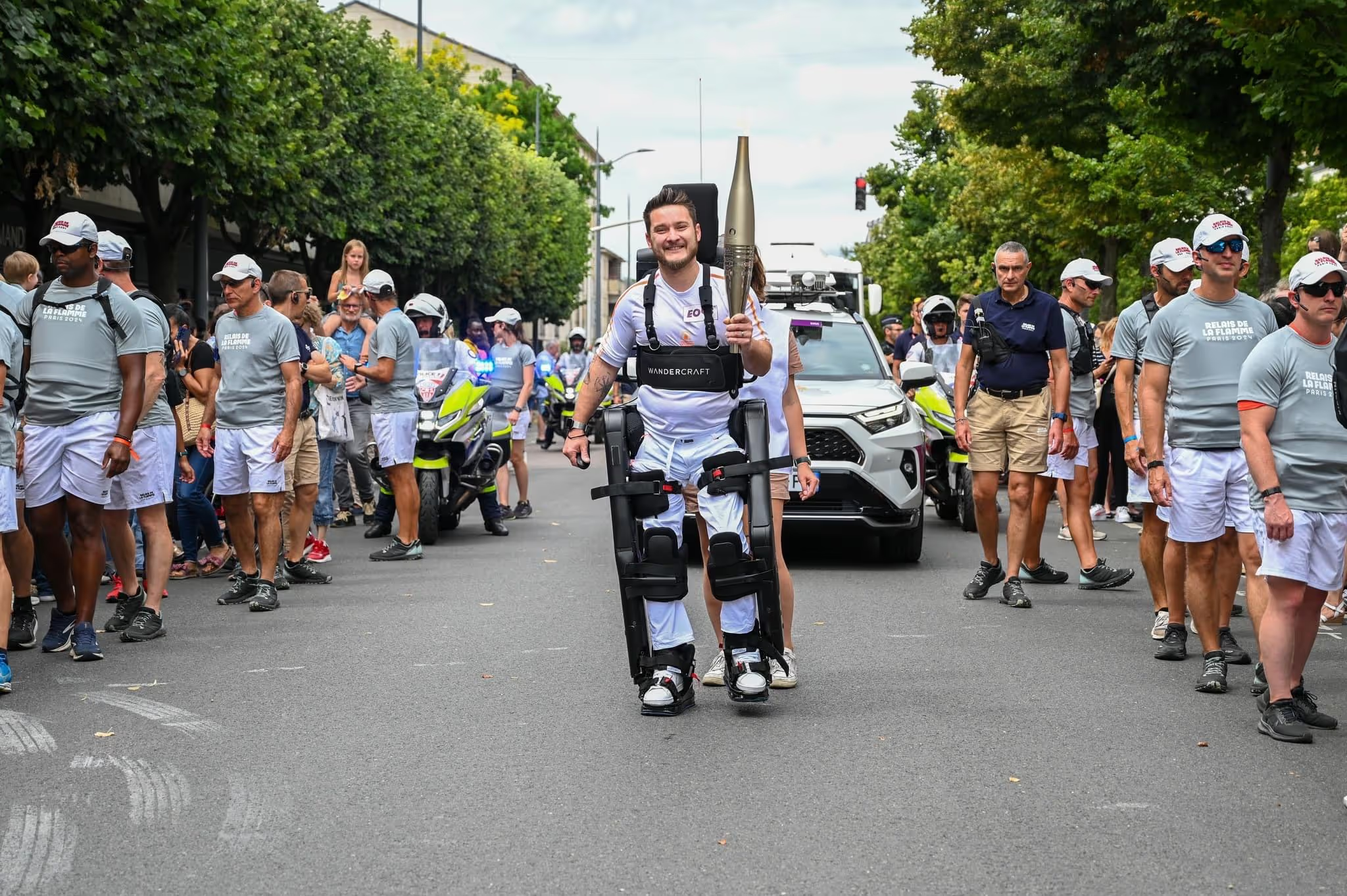
This phase also marks a gradual decrease in costs, linked to the miniaturization of electronics, the improvement of batteries and the optimization of industrial processes. These dynamics will then benefit exoskeletons intended for the world of work.
2. Exoskeletons are making their way among the pros
a. The emergence of exoskeletons at work: targeted uses
In France, the first documented industrial uses appeared from 2015. They mainly concern passive and rigid exoskeletons, often dedicated to a specific function. Shoulder assistance devices, used for hands-on work (painting, wiring, assembly), are the first family to be of real operational interest. Their success is based on a clearly defined scope of use and a quick understanding of their benefit.
Gradually, exoskeletons for the back are becoming the majority segment of the market. Two main approaches stand out:
- passive textile exoskeletons, which are very light and accessible, which rely above all on acceptability and ease of use;
- active exoskeletons, integrating motors and sensors, capable of providing modular and measurable assistance, at the cost of greater technological complexity.
The history of the market shows that devices that are too heavy or too general have had difficulty establishing themselves. Conversely, solutions combining functional targeting, compactness and gradual integration into organizations have found their place.
b. Acceptability, integration and prevention framework
Feedback quickly showed that biomechanical performance alone is not enough. Studies have shown that some exoskeletons can generate stresses that are displaced to other body segments if they are poorly chosen or poorly integrated. These observations contributed to holding back the market in its early years and to strengthening the requirement for scientific and methodological validation.
Prevention organizations, in particular INRS, played a key role in recalling that exoskeletons must be part of a global approach: analysis of work situations, priority search for organizational or technical solutions, then, where appropriate, then, where appropriate, gradual integration of a DAP with long-term follow-up. The publication of methodological guides and, more recently, of the standard AFNOR NF X35-800 in 2023, made it possible to structure these integration approaches without standardizing the products themselves.
c. Expertise built in the field: the Japet Medical approach
It is in this context of maturation that Japet Medical has developed. The company positioned itself very early on back exoskeletons, choosing an active, compact and textile device, designed to reconcile biomechanical efficiency, acceptability and field integration.
From the very beginning, Japet has undertaken clinical and scientific work in collaboration with medical and university teams, in order to objectify the impact of its solutions, in particular on the reduction of lumbar constraints and pain. This evidence-based approach sets Japet apart in a market long dominated by technical demonstrators.
At the same time, the company has structured its industrial development and quality according to medical device standards, based on an ISO 13485 certified quality system. This level of requirement, which is still rare in the field of exoskeletons at work, reflects a clear desire: to guarantee the safety, reliability and reproducibility of performances over the long term.
D. From experimentation to sustainable use
The exoskeleton market at work remains characterized by targeted deployments. To date, there are no universal solutions that massively equip an entire company. On the other hand, a major evolution is observable: some exoskeletons are now used continuously for several years on identified positions, with trained and voluntary users.
This durability of use marks a turning point compared to the first experiments at the end of the 2010s. It reflects both a better product-use fit, a more rigorous integration and an evolution in the social acceptability of these devices.
3. Prospects: towards controlled diversification
MSDs remain the leading cause of occupational diseases in France, in a context of aging of the active population and the extension of careers. Exoskeletons are now a complementary tool, serving the preservation of health rather than the search for short-term productivity.
Current market trends are moving towards a twofold dynamic:
- ever simpler, lighter and more accessible solutions, allowing wide distribution, including among SMEs, artisans and communities ;
- devices with higher added value, integrating sensors and usage data, capable of adapting to a wide variety of work situations.

Like the evolution of orthotics over the last twenty years, the exoskeleton is tending to become an accepted, and even claimed, object as its design, comfort and usefulness progress.
Conclusion
The story of exoskeletons is that of a gradual transition from research to professional use. After decades of experimentation, the sector is entering a phase of maturity, driven by increased requirements in terms of proof, integration and acceptability.
Based on technical, clinical and field expertise built over more than ten years, Japet Medical is part of this long-term trajectory: that of exoskeletons designed not as a technological promise, but as a concrete tool in the service of health and sustainable retention of people at work.